
Before you begin, take time to explore the tool. Understand what it offers, how the self-assessment works, and what resources are available. This helps you feel prepared and confident before starting the main process.
HEInnovate: Shaping the future of higher education together
HEInnovate is an initiative of the European Commission and the OECD. It helps higher education institutions become more entrepreneurial, innovative, and future-ready.
It offers a complete framework for change — guiding you from reflection to action. With HEInnovate, your university can assess its current position, design action plans, and access practical resources to turn ideas into impact.
Understand where you are today. Decide where you want to be tomorrow. Take concrete steps to get there.
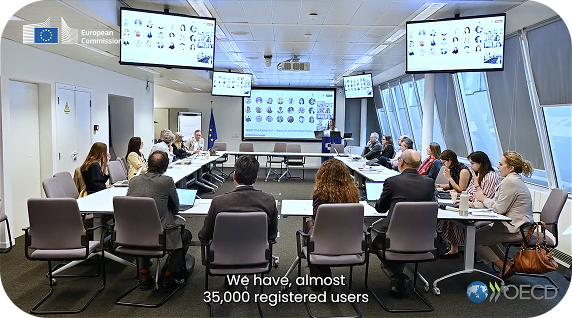
HEInnovate helps higher education institutions:
Understand where they stand and where to go next
Get a clear, evidence-based picture of your institution’s innovation and entrepreneurship capacity across eight key dimensions.
Use the self-assessment to identify your strengths, reveal blind spots, and build a shared understanding of your starting point.
Benefit: You move from intuition to insight — with data that drives informed decisions.
Build alignment and a shared vision
HEInnovate brings together perspectives from leadership, staff, students, and partners. It creates a common language for change.
This enables discussion on what entrepreneurship means in each context. It also helps establish shared priorities.
Benefit: Transformation becomes a collective journey owned by your whole community.
Turn insight into action
Move from reflection to results using practical tools such as Action Cards, case studies and planning templates.
Design initiatives, set goals, and assign responsibilities. Create a strategic roadmap tailored to your vision.
Benefit: Turn ideas into implementation, with guidance at every step.
Connect to European funding opportunities
Use your results to shape an Innovation Vision Action Plan (IVAP). Link it to EU programmes such as the EIT Higher Education Initiative (EIT HEI).
Access funding, partnerships, and a European community of peers pursuing the same goals.
Benefit: Scale your impact beyond your campus – connecting local change to Europe’s innovation ecosystem.
The tool is confidential, available in all EU languages, and open to all types of Higher Education Institutions. Results are delivered instantly, along with tailored learning resources and access to a community of experts.
Your HEInnovate journey
The steps below guide you through the features and content of HEInnovate. Click on the carousel to see how to use HEInnovate for an individual or group self-assessment.
Recommended resources:
- User Stories - See how other institutions have used HEInnovate to guide change
- Case Studies - Discover good practices in innovation and entrepreneurship across the 8 dimensions
- Description of the 8 Dimensions - Understand the dimensions that HEInnovate assesses
- Guidance Notes - Review detailed explanations of each statement in the self-assessment to better understand what you are evaluating
- HEInnovate Foundation Guide - A practical introduction to HEInnovate, guiding institutions through the full transformation journey from reflection to action
- HEInnovate Transformation Journey for Alliances - A practical guide supporting European Universities alliances in applying HEInnovate collaboratively across partners.
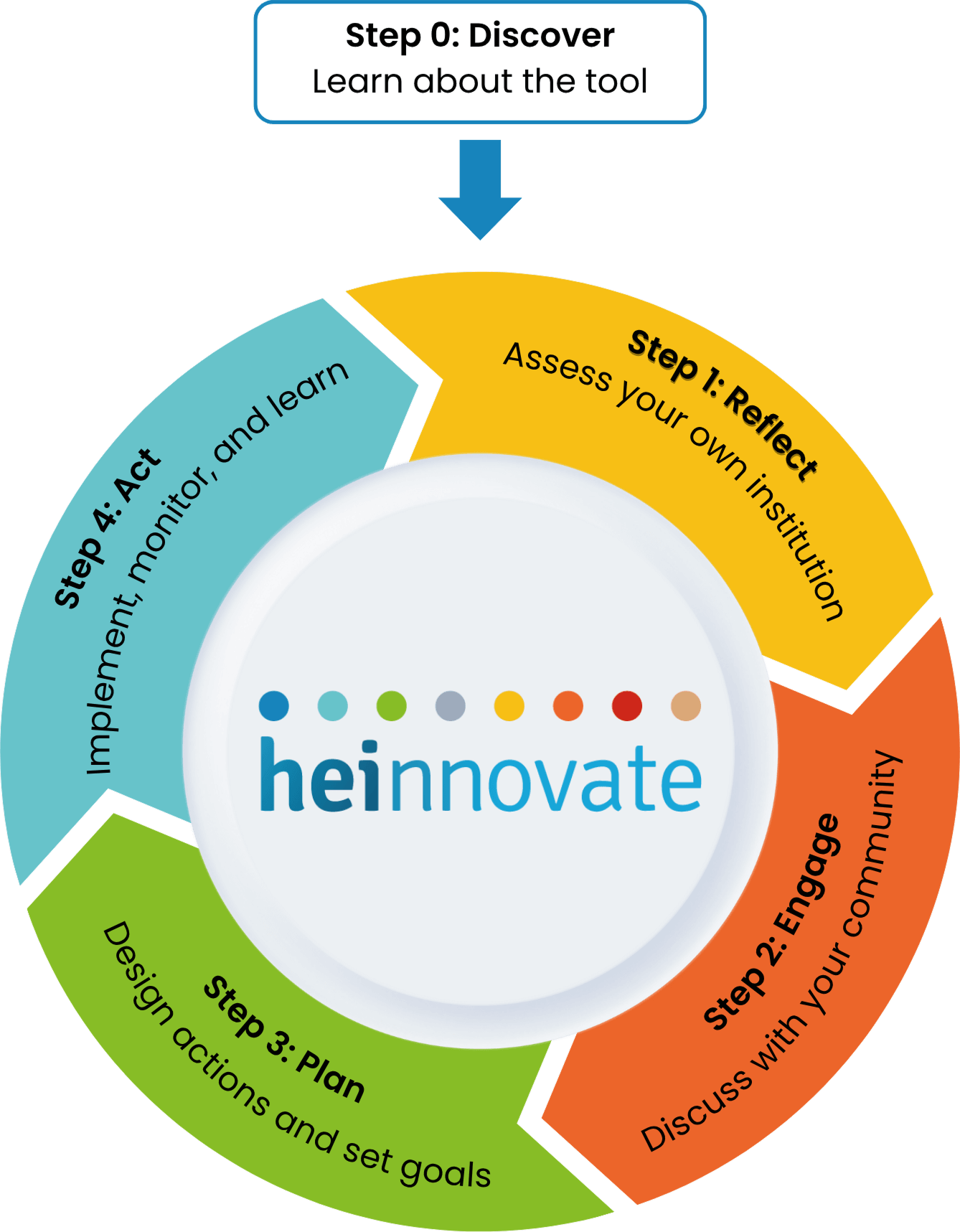
Start your journey with the HEInnovate self-assessment. Create a group, invite colleagues, and gather perspectives from across your institution on the 8 key dimensions of innovation and entrepreneurship.
When everyone completes their assessment, HEInnovate automatically aggregates the results. It shows where opinions align and where they differ. This shared evidence base becomes the foundation for your next discussions and decisions.
Recommended resources:
- Description of the 8 Dimensions - Explore what each dimension measures
- Guidance Notes - Get detailed interpretations of each statement you will assess
- Quick Start Guide: Self-Assessment - Step-by-step guidance for completing the HEInnovate self-assessment as an individual, group participant or organiser.
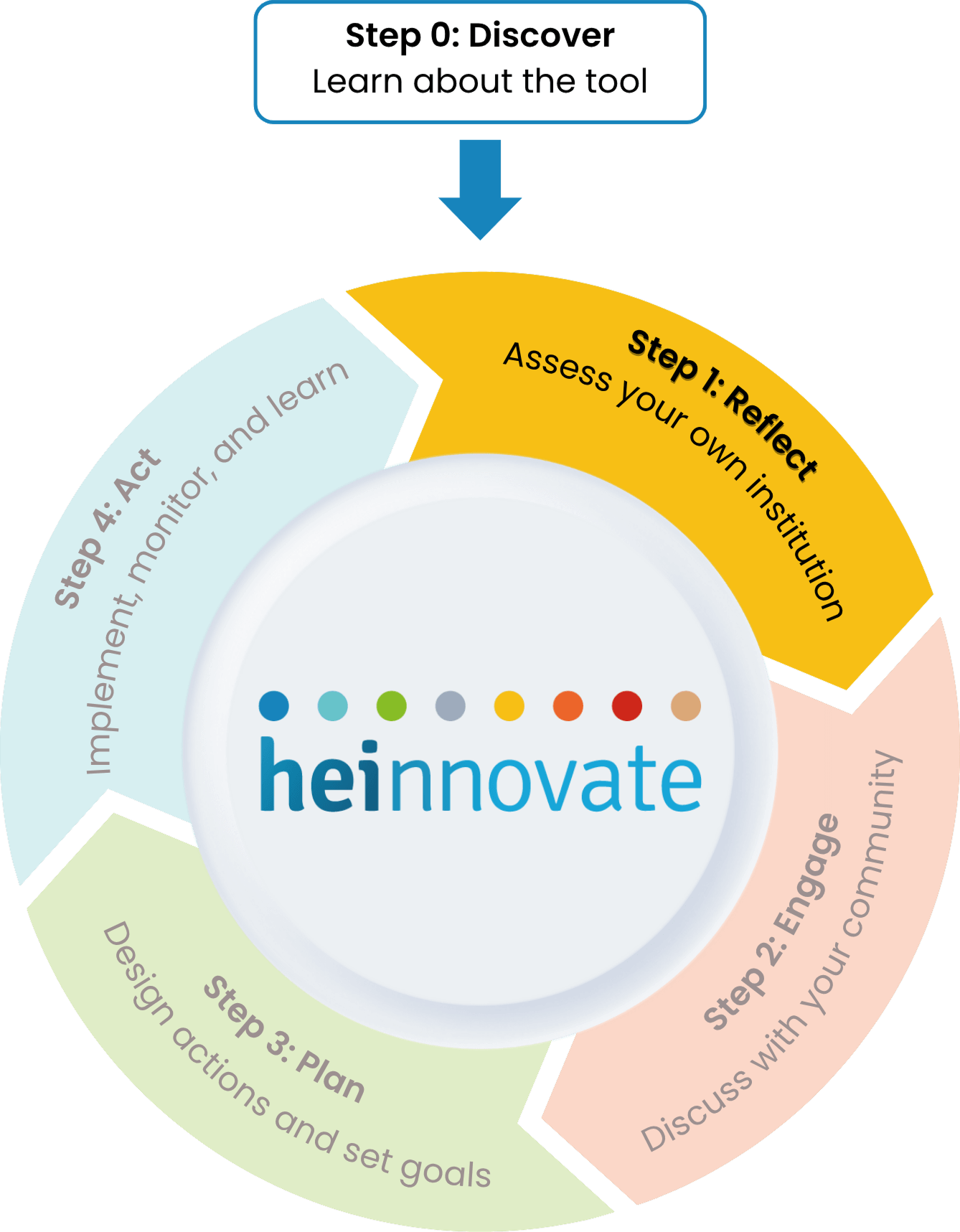
Once your results are ready, bring people together to explore what they mean. Organise a workshop or discussion to ask: Why do these results look the way they do? Identify underlying causes, discuss differences, and agree on priorities for change.
You can invite representatives from each group that completed the self-assessment, or hold a smaller session — whatever fits your context. This step helps your community build shared understanding, ownership, and commitment to action.
Recommended resources:
- Workshop Guide - Ready-to-use materials for group sessions
- User Stories - Examples of how institutions have used HEInnovate to engage their communities
- Stakeholder Engagement Toolkit - Practical tools to identify, map and engage key stakeholders throughout the HEInnovate journey.
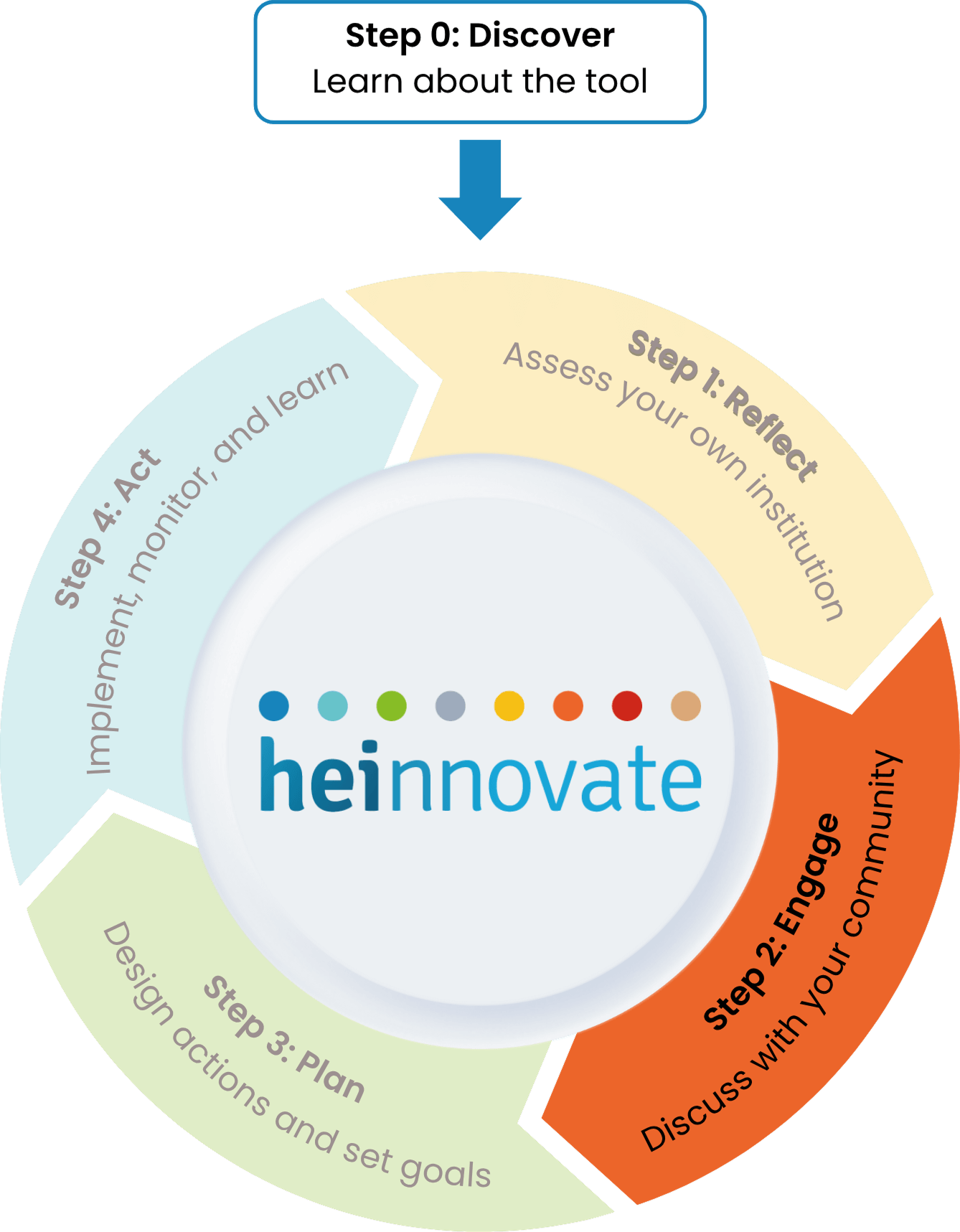
With insights and alignment in place, it’s time to design your strategic roadmap for change. Use HEInnovate’s Action Cards, planning templates, and case studies to decide what to do next.
Action Cards offer tailored recommendations and ideas based on your results. Templates help you translate them into concrete steps.
Recommended resources:
- Action Cards - Tailored recommendations and inspiration linked to the 8 dimensions
- Action Planning Board – Dimensions - Visual tool for mapping short-, medium-, and long-term actions
- Work Package Planning Board - Template to cluster and organise activities for implementation
- Training Manual - Guidance and examples to support planning sessions
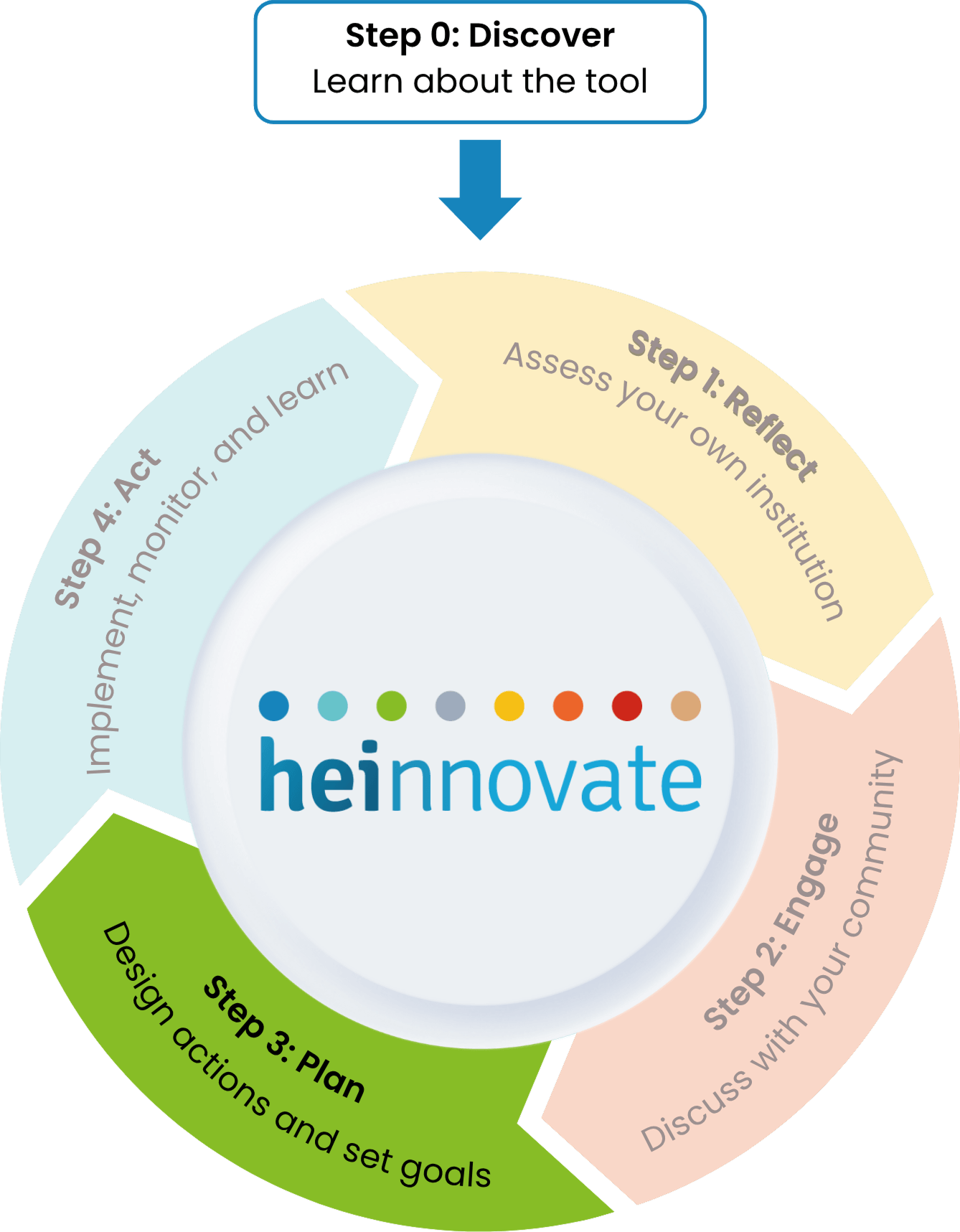
Now, put your plans into motion. Launch new initiatives, strengthen collaboration, and build capacity for entrepreneurship and innovation across your institution.
You can also use your HEInnovate Action Plan as the foundation for an Innovation Vision Action Plan (IVAP). This is eligible for EIT Higher Education Initiative (EIT HEI) funding, which offers access to European partnerships and networks.
Remember — transformation is ongoing. Revisit HEInnovate regularly to repeat the self-assessment, reflect on progress, and update your action plan for continuous improvement.
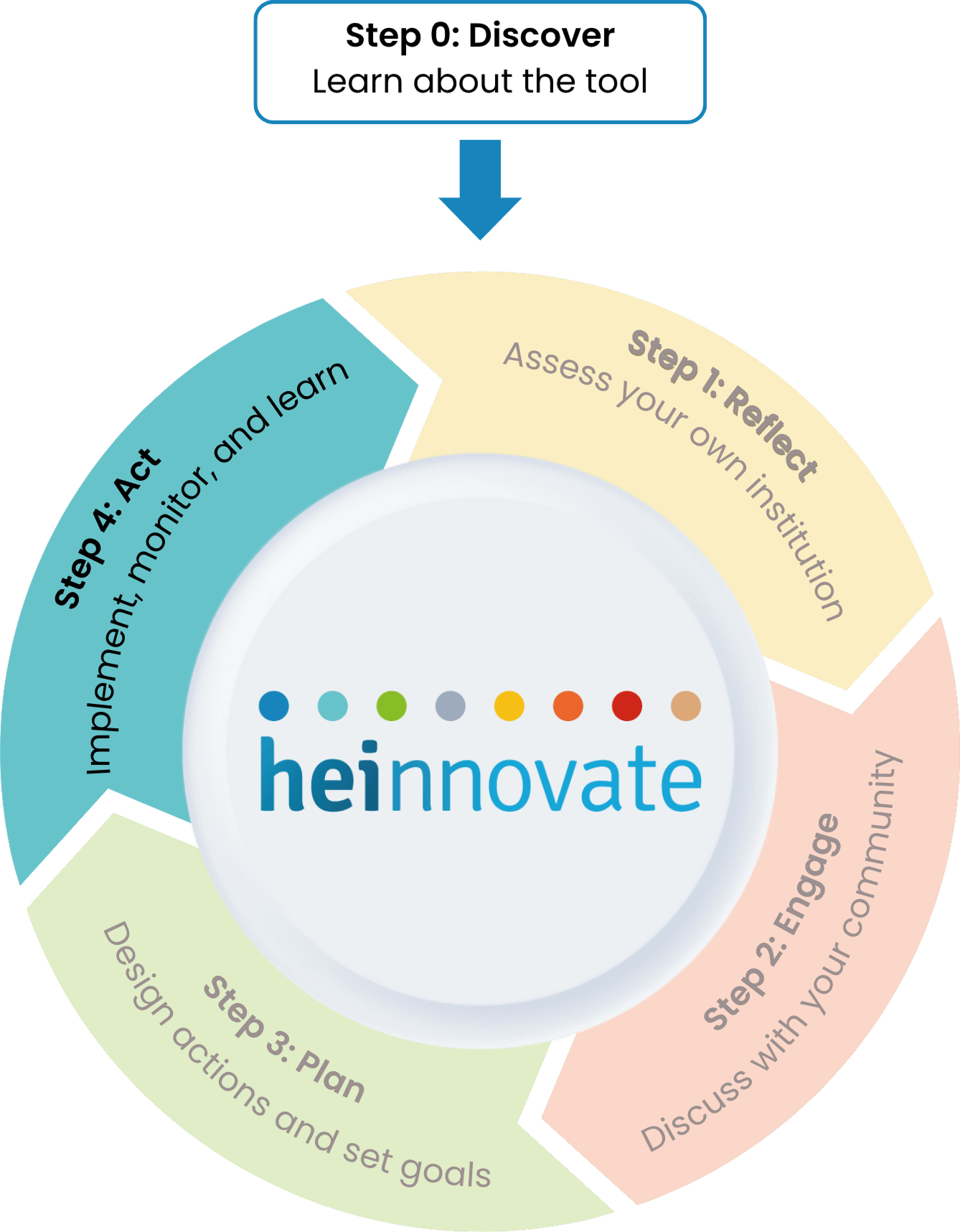
Step 0: Discover — Learn about the tool
Before you begin, take time to explore the tool. Understand what it offers, how the self-assessment works, and what resources are available. This helps you feel prepared and confident before starting the main process.
Recommended resources:
- User Stories - See how other institutions have used HEInnovate to guide change
- Case Studies - Discover good practices in innovation and entrepreneurship across the 8 dimensions
- Description of the 8 Dimensions - Understand the dimensions that HEInnovate assesses
- Guidance Notes - Review detailed explanations of each statement in the self-assessment to better understand what you are evaluating
- HEInnovate Foundation Guide - A practical introduction to HEInnovate, guiding institutions through the full transformation journey from reflection to action
- HEInnovate Transformation Journey for Alliances - A practical guide supporting European Universities alliances in applying HEInnovate collaboratively across partners.
Step 1: Reflect — Assess your institution
Start your journey with the HEInnovate self-assessment. Create a group, invite colleagues, and gather perspectives from across your institution on the 8 key dimensions of innovation and entrepreneurship.
When everyone completes their assessment, HEInnovate automatically aggregates the results. It shows where opinions align and where they differ. This shared evidence base becomes the foundation for your next discussions and decisions.
Recommended resources:
- Description of the 8 Dimensions - Explore what each dimension measures
- Guidance Notes - Get detailed interpretations of each statement you will assess
- Quick Start Guide: Self-Assessment - Step-by-step guidance for completing the HEInnovate self-assessment as an individual, group participant or organiser.
Step 2: Engage — Discuss with your community
Once your results are ready, bring people together to explore what they mean. Organise a workshop or discussion to ask: Why do these results look the way they do? Identify underlying causes, discuss differences, and agree on priorities for change.
You can invite representatives from each group that completed the self-assessment, or hold a smaller session — whatever fits your context. This step helps your community build shared understanding, ownership, and commitment to action.
Recommended resources:
- Workshop Guide - Ready-to-use materials for group sessions
- User Stories - Examples of how institutions have used HEInnovate to engage their communities
- Stakeholder Engagement Toolkit - Practical tools to identify, map and engage key stakeholders throughout the HEInnovate journey.
Step 3: Plan — Design actions and set goals
With insights and alignment in place, it’s time to design your strategic roadmap for change. Use HEInnovate’s Action Cards, planning templates, and case studies to decide what to do next.
Action Cards offer tailored recommendations and ideas based on your results. Templates help you translate them into concrete steps.
Recommended resources:
- Action Cards - Tailored recommendations and inspiration linked to the 8 dimensions
- Action Planning Board – Dimensions - Visual tool for mapping short-, medium-, and long-term actions
- Work Package Planning Board - Template to cluster and organise activities for implementation
- Training Manual - Guidance and examples to support planning sessions
Step 4: Act — Implement, monitor, and learn
Now, put your plans into motion. Launch new initiatives, strengthen collaboration, and build capacity for entrepreneurship and innovation across your institution.
You can also use your HEInnovate Action Plan as the foundation for an Innovation Vision Action Plan (IVAP). This is eligible for EIT Higher Education Initiative (EIT HEI) funding, which offers access to European partnerships and networks.
Remember — transformation is ongoing. Revisit HEInnovate regularly to repeat the self-assessment, reflect on progress, and update your action plan for continuous improvement.
Explore what makes and institution innovative: the eight dimensions of HEInnovate
Explore the eight dimensions of HEInnovate by completing the self-assessment. Under eight dimensions, there are 38 statements to consider in relation to your institution.
Leadership and Governance
Entrepreneurial leadership and accountable governance are crucial to developing an entrepreneurial and innovative culture within an higher education institution (HEI). Such leadership defines entrepreneurship as a strategic priority. It takes entrepreneurial and innovative practices from one-off experiments to an integrated approach that is core to how the HEI undertakes teaching, research, and knowledge exchange.
- Entrepreneurship and innovation are a major part of the HEI’s strategy. Read More
- Leadership of the HEI demonstrates entrepreneurial attitude and competences that drive institutional change. Read More
- There is a structure/system for coordinating and integrating entrepreneurial activities across the HEI to facilitate the implementation of the institutional entrepreneurial agenda.
Read More - The HEI encourages and supports faculties, departments, units, teams and individuals to act entrepreneurially. Read More
- The HEI is a driving force for entrepreneurship and innovation in regional, social, community development and addressing societal challenges. Read More
Organisational Capacity: People, Resources, Incentives and Rewards
The organisational capacity of a higher education institution drives its ability to deliver on its entrepreneurial strategy. If a higher education institution HEI is committed to carrying out entrepreneurial activities to support its strategic objectives, key resources need to be in place. These include people, funding, investments, expertise, knowledge, and reward and incentive systems — all essential to sustain and grow its capacity for entrepreneurship and innovation.
- Entrepreneurship and innovation are supported by the institutional culture and sustainable funding. Read More
- Building new relationships and synergies are fostered by supportive institutional policies. Read More
- The HEI engages, recruits and promotes individuals with entrepreneurial attitudes, behaviour and experience. Read More
- The HEI invests in staff training and development to support its entrepreneurial and innovative agenda. Read More
- Rewards, incentives and recognition in career progression are given to staff who actively support the entrepreneurial and innovative agenda of the HEI.
Read More
Entrepreneurial Teaching and Learning
Entrepreneurial teaching and learning involve exploring pedagogies, practices, and flexible learning pathways to stimulate entrepreneurial mindsets in an inclusive and sustainable way. Creating a start-up remains a powerful and versatile pedagogical tool. But entrepreneurship education is not just learning about how to transform an idea into a sustainable business. It is also about gaining exposure to entrepreneurial experiences. It means acquiring the skills and competences needed to develop an entrepreneurial mindset. And it equips students to contribute to addressing challenging issues such as sustainability and the United Nations Sustainable Development Goals (SDGs).
- The HEI provides diverse formal learning opportunities including the use of flexible learning pathways to develop entrepreneurial mindsets and competences. Read More
- The HEI provides a wide range of informal learning opportunities and experiences to stimulate the development of entrepreneurial mindsets and competences. Read More
- The HEI validates and assesses entrepreneurial learning outcomes and impacts. Read More
- The HEI co-designs and delivers a curriculum with external stakeholders which responds to societal challenges. Read More
- Results of entrepreneurship research are integrated into teaching and learning activities. Read More
Preparing and Supporting Entrepreneurs
Higher education institutions can help students, graduates, and staff consider starting a business as a career option. At the outset, it is important to help individuals reflect on the commercial, social, environmental, and lifestyle objectives related to their entrepreneurial aspirations and intentions. For those who decide to start a business or other type of venture, targeted assistance can be offered. This includes generating and evaluating ideas, building the skills necessary for successful entrepreneurship, finding relevant team members, and getting access to appropriate finance and effective networks. In offering such support, a higher education institution should ideally act as part of a wider business support ecosystem rather than operating in isolation.
- The HEI increases awareness of entrepreneurship and stimulates the entrepreneurial intentions of students, graduates and staff to start-up a business or venture. Read More
- The HEI supports its students, graduates and staff in starting, running and growing a business or new venture. Read More
- Mentoring and other forms of personal and entrepreneurial project development are offered. Read More
- The HEI offers or facilitates access to business incubation, acceleration, and financing. Read More
- Global challenges are reflected in the HEI's entrepreneurial initiatives.
Read More
Digital Transformation and Capability
Higher education institutions are already deploying digital technologies. However, uptake and integration vary among and within institutions. Institutions should make the most of the opportunities presented by digital transformation and consider digital technologies as a key enabler of innovation and entrepreneurship. Digital capability is defined as the ability to integrate, optimise, and transform digital technologies to support innovation and entrepreneurship.
- The HEI fosters a digital culture and implements and monitors a digital strategy supporting innovation and entrepreneurship.
Read More - The HEI invests in, manages and continuously improves a digital infrastructure that supports innovation and entrepreneurship.
Read More - The HEI actively supports the use of digital technologies to enhance quality and equity in entrepreneurial teaching, learning and assessment. Read More
- The HEI actively uses open educational resources, open science and open data practices to improve the performance of the institution and increase impact on its entrepreneurial ecosystem. Read More
- The HEI makes full use of its digital capacity to promote sustainable and inclusive innovation and entrepreneurship. Read More
Entrepreneurial Ecosystem and Networks
An entrepreneurial and innovative institution proactively connects with its ecosystem. An ecosystem is an array of interlinked actors pooling skills and resources to pursue a common goal. The aim is to deliver social, cultural, and economic benefits. The capacity to connect with entrepreneurial ecosystems and networks is an important catalyst for organisational innovation. It helps advance teaching and research. It also transforms the institution into an important actor in regional development and territorial cohesion.
- The HEI creates effective collaboration and enhances synergies with its entrepreneurial ecosystem and networks. Read More
- The HEI is an active partner in developing and implementing local and regional entrepreneurial and innovation strategies. Read More
- The HEI has strong links with incubators, accelerators, science parks and other external initiatives supporting the development of a sustainable entrepreneurial ecosystem. Read More
- The HEI integrates research, education and knowledge exchange to build resilient communities. Read More
The Internationalised Institution
A sustainable entrepreneurial institution integrates internationalisation into the design and delivery of education, research, and knowledge exchange. It does so by introducing new questions, approaches, and alternative ways of thinking. By considering international societal challenges — including the Sustainable Development Goals (SDGs) — the entrepreneurial institution becomes better equipped to support its ecosystem.
- The HEI reflects on global trends, societal and ecological challenges in its entrepreneurial agenda. Read More
- The HEI explicitly supports inclusive and sustainable forms of mobility of its staff and students. Read More
- The HEI's entrepreneurial agenda contributes to global and social cohesion, mitigation of climate change and the HEI carbon neutrality. Read More
- The HEI engages in deep transnational cooperation with other European HEIs. The HEI places European cooperation at the core of its strategy and considers it as a driver for creativity and innovation. Read More
- The HEI pursues international engagement across all its activities: teaching, research and knowledge exchange to deliver impact at local, regional, national and international levels. Read More
Impact of the Entrepreneurial HEI
Entrepreneurial and innovative higher education institutions need to understand the impact of the changes they bring about. The entrepreneurial institution combines institutional self-perception, external reflection, and an evidence-based approach. An institution that monitors the impact of all activities connected to its entrepreneurial and innovation agenda generates valuable information and data to improve its own performance. Metrics should span beyond spin-off creation, intellectual property generation, and research income. Assessment activities should also focus on graduate entrepreneurship, skills and competence development, teaching and learning outcomes, talent retention, and contribution to global, national, and local economic development — or the impact of the institution's broader entrepreneurial agenda.
- The impact of the HEI’s entrepreneurial activities is regularly assessed across all its activities. Read More
- The HEI assesses the impact of its entrepreneurial agenda with key performance indicators, narratives and dedicated assessment tools. Read More
- The performance indicators allow for comparisons with other national or international peers. Read More
- The learning generated from the assessment of impact drives the further development of the entrepreneurial and innovation activities of the HEI to enhance its future impact. Read More
News & events
Read the latest HEInnovate news and see our upcoming events. You can also sign up
to our news and newsletter to receive notifications and updates from the HEInnovate community.
Upcoming events
- CEI
- Event
- Contains controls to share this content on social networks or by email.Share this page
The Community for Educational Innovation (CEI) invites motivated professionals to apply for the CEI Study Visit 2026-II, taking place on 3–4 November 2026 and hosted by the Polytechnic University of Viana do Castelo, Portugal. This immersive, fully funded visit will explore how lifelong learning can strengthen Europe’s innovation capacity by...
- Event
- Webinar
- Contains controls to share this content on social networks or by email.Share this page
Prepare for the New EIT HEI Funding Call: Master HEInnovate! Join us on November 6th from 15:00 to 16:30 CET for an essential webinar introducing HEInnovate—a free self-assessment tool crucial for preparing your application to the upcoming EIT HEI funding call. Designed to help higher education institutions explore and strengthen their...
Recent news
- News
- Contains controls to share this content on social networks or by email.Share this page
From Lithuania to Scotland to Austria, September brought HEInnovate to three major European higher education gatherings, each offering a reminder of how much the community has to share. EAIR 2026: Trust, Society and the HEInnovate Framework 📍 Vilnius University (Lithuania) | 26-28 August 2026 At the...
- News
- Contains controls to share this content on social networks or by email.Share this page
The HEInnovate Expert Group is growing. We are delighted to welcome seven new members who bring a wealth of experience in entrepreneurship, innovation and higher education policy from across Europe. The HEInnovate Expert Group is a driving force behind the platform's continued development. Bringing...
Learn from other universities
View and download case studies that showcase different institutional approaches and practices along the eight dimensions of HEInnovate. Explore user stories about the experiences of various institutions undertaking the HEInnovate assessment.
- User stories
by Fernando C. Gaspar Abstract ISCAL used HEInnovate to assess how its existing entrepreneurial and innovative activities could be better connected, communicated and made accessible across the institution. The self-assessment and workshops confirmed that substantial activity was already taking place but was not yet fully visible, coordinated or used to its full potential. The process resulted in four complementary proposals: mapping existing initiatives, creating a visible gateway to entrepreneurial support, developing a more systematic picture of entrepreneurship and innovation across ISCAL...
- Case studies
The Campus Incubators Programme in Helsinki brings together the City of Helsinki and higher education institutions to strengthen very early-stage entrepreneurship support. Aalto University, the University of Helsinki and Metropolia University of Applied Sciences deliver complementary pre-incubation activities that help students, researchers and other potential entrepreneurs develop ideas, build entrepreneurial skills and progress towards further incubation and acceleration. The case highlights the importance of public support, institutional embedding and cooperation across the local start-up...
Expert group
The expert group is an important driving force behind taking HEInnovate forward. In this section you can read the profiles of our experts and contact them.

Thomas Crispeels is a professor of Entrepreneurship and Innovation and chair of the Brussels Entrepreneurship and Innovation Lab at the Vrije Universiteit Brussel. His research centres on the role of academia in a modern, technology-driven society...

Bernhard Weber is the Managing Director of ZWI – Centre for Knowledge and Innovation Transfer GmbH (Unicorn Start-up & Innovation Hub) in Graz, Austria, a position he has held since 2016. He oversees the strategic direction, establishment, and...

Ana-Cristina Nicolescu is Vice-Dean of the Faculty of Economics and Business Administration at West University of Timișoara, Romania, responsible for quality assurance, institutional accreditations, certifications, and rankings, as well as a Full...
The European Commission launched HEInnovate in partnership with the OECD in 2013. As one of the Erasmus+ programme tools, it is embedded in EU policy and funding initiatives. This makes it a trusted starting point for transformation.