
Aligning Innovation across Nine Universities: HEInnovate in the EU GREEN Alliance
by Hernâni Barros Zão Corga Oliveira
Abstract
Within the EU GREEN Alliance, nine universities from nine countries1 used HEInnovate to build a shared approach to innovation and knowledge transfer. Each university completed the HEInnovate self-assessment and the results were discussed in an intensive workshop held during the Alliance's sustainability festival and staff week in 2025. This created a common baseline for discussion and gave staff at different levels a voice in describing their own institutions. The Alliance used the results to refine its work on innovation and entrepreneurship for sustainability and to feed into its application to the 2026 Erasmus+ European Universities call. The testimonial reflects how the self-assessment helped nine very different realities align around innovation and why bringing it in early matters.
 Could you tell us about yourself and your role in the EU GREEN Alliance?
My name is Hernâni Oliveira. I am a researcher and invited professor at the University of Évora in Portugal and my background is in knowledge valorisation — how we use the knowledge created in universities to improve people’s quality of life and their access to good information. Within the EU GREEN Alliance, I coordinate Work Package 4, which is dedicated to Innovation and Entrepreneurship for Sustainability.
EU GREEN unites nine universities from nine countries, and we have been working together since 2023. Our focus is sustainability in a broad sense — not only environmental, but also social, cultural and inclusive. My role is to raise awareness of the importance of knowledge valorisation across the Alliance and to help students, researchers and professors look at their own work and ask a simple question: is this good for society and for the market and how do we bring it there?
What led you to HEInnovate and what kind of activity did you take part in?
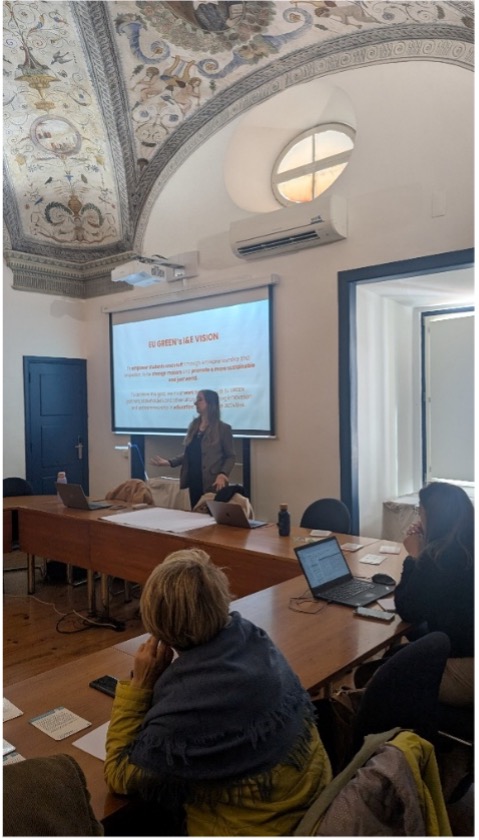
The challenge in an Alliance like ours was that we wanted the same approach inside all nine universities and that is difficult when you work with nine very different realities. We needed an honest diagnosis of how knowledge and technology transfer actually happens in each place — the challenges, the opportunities and the vision for the future. Therefore, I invited the HEInnovate team to one of our sustainability festivals, where we also hold our Work Package 4 staff week. Before the workshop, each university completed the HEInnovate self-assessment on its own; during the workshop, we worked with the overall results — not each university's individual answers — and used them as a baseline to discuss where we stood and where we wanted to go together. The workshop had two goals: first, to align the institutions; and second, to help shape our proposal for the 2026 Erasmus+ European Universities call, in which we wanted to segment our activities more clearly for different audiences.
What was most valuable about working with HEInnovate?
 The most valuable part was the way HEInnovate democratised the voices inside our universities. We work with many people — knowledge transfer office technicians, researchers, professors, pro-rectors and vice-rectors — and the ones who implement things every day are often not used to giving an opinion about their own institution. Some of them felt they first had to check with their vice-rector before answering. The HEInnovate team reassured them that these were their own perspectives and that having different viewpoints was entirely legitimate.
Because we discussed the overall results and did not single out individual universities, people had a safe space where they could speak openly, without feeling that pointing to something that is not working means going against their institution. People were sceptical at the beginning, because they did not know the tool, but afterwards they told me they wanted to keep working with it. Having a neutral facilitator from outside the Alliance also made a real difference, offering a perspective separate from day-to-day coordination.
What did the self-assessment reveal about your Alliance?
One clear strength was that all our universities really value knowledge and technology transfer. You can see it in practice — there are more vice-directors for innovation now, not only for research and the third mission is moving from strategic plans into implementation. The critical point was human resources. Knowledge valorisation is still a young field for many universities, and you can find a single person responsible for the whole university. The willingness to do more is there and significant efforts go into recruitment, but these efforts do not always translate into results. The willingness is there across the Alliance; how to do it is the harder part.
What actions did you take after the workshop?
The workshop led to real changes. Our main decision was to focus on fewer activities with more impact. For example, we used to run an event just to raise awareness of EU GREEN and Work Package 4; now that message is part of the mindset of our students and professors, so we were able to put that energy into activities that bring more value instead.
We also applied insights from the workshop directly in our subsequent Innovation Days and built the insights into our internal strategy. During the session, we identified which steps in the EU GREEN entrepreneurship programme were no longer necessary and which areas should be explored further. For example, we decided to discontinue the Inspiration Days sessions that preceded the Innovation Days because they required considerable effort relative to their impact. We also created a new line of work focused on the commercialisation of innovation and discussed integrating process automation tools to increase student engagement and encourage the exchange of experiences throughout the entrepreneurial journey.
The next step was to include the collaboration with HEInnovate as one of the concrete tasks in our application for the next phase, so it becomes a regular part of our work rather than a one-off. The results also fed into how we designed that next phase for EU GREEN — for example, in deciding how to segment our activities more clearly for different audiences. We hope to continue working with HEInnovate from 2027 onwards, if our application is successful.
Was there anything the assessment pointed to that you chose not to pursue?
We are always keen to have an impact in our regions — not only from the university to the market, but also from the region back to the university. The HEInnovate self-assessment pushed us to discuss our regional innovation ecosystem and how we could connect external stakeholders across all our regions, almost like an innovation hub inside the Alliance. Everyone recognised the value of this idea, but at the same time we were realistic about the challenges we face. Limited human resources and the complexity of building strong connections between universities and their regional ecosystems make this a demanding task. So instead of committing to a full framework of action, we chose a lighter approach: keeping external stakeholders close through a few meetings during the year as well as through surveys that help us identify opportunities and by bringing them into the new digital platform we are building for EU GREEN. It was not exactly what we first wanted, but it came from listening to our real constraints rather than overpromising.
What are your main lessons and recommendations for other Alliances?
My main recommendation is to involve HEInnovate early. In our first year we had to write an action plan as our first deliverable, and the HEInnovate self-assessment would have been a perfect basis for it — it would have given us more alignment from the start. We started working with HEInnovate once our activities were already planned, which still worked well, but earlier would have been even better.
That said, it is never too late. More than anything, HEInnovate gave us a shared language for discussing innovation and knowledge transfer across nine very different institutional contexts. Sometimes we think we are completely aligned, but we have not really discussed our different realities enough. HEInnovate helps you do exactly that, while ensuring that the voices of the people who work in the field every day are heard. And it is simple — the self-assessment takes only a few minutes and people identify much more with a project when the tools are easy to use. That, for me, is what makes it powerful.
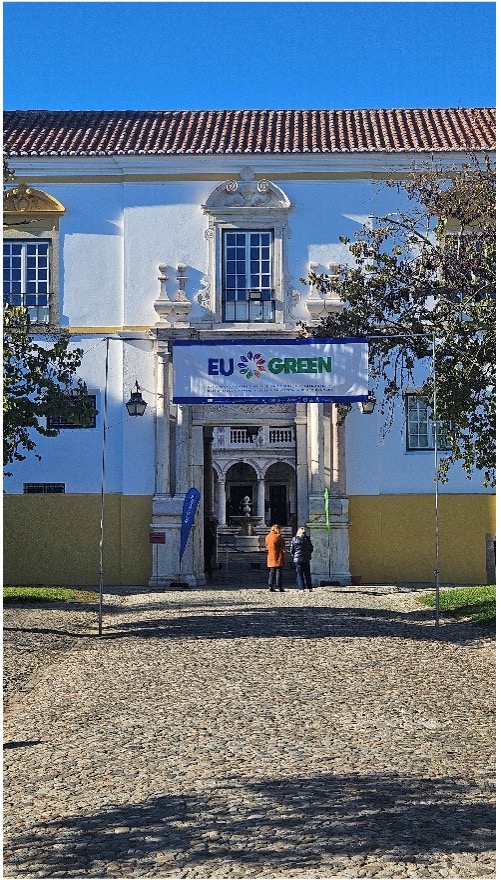
The workshop was held on 27th November 2025 at the University of Évora, Portugal. Find the news article about the workshop here.